Articles · Hints & Tips
How to Tell If Your Website Is Out of Date
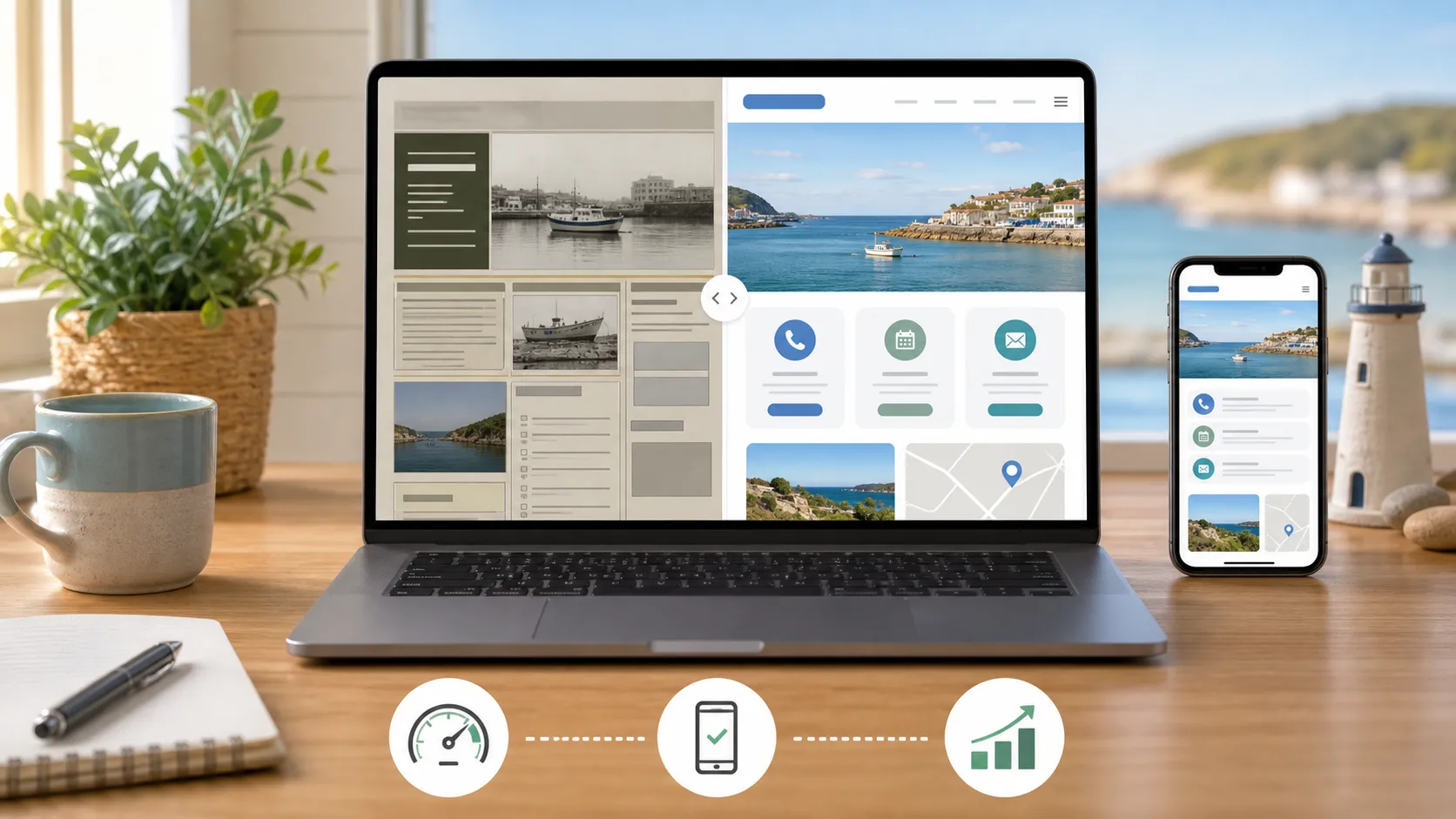
Not sure whether your website needs a refresh? Here are the common signs that a business website is starting to feel outdated, from slow loading and poor mobile usability to old content and weak trust signals.
Websites do not usually become outdated overnight.
They age quietly.
One year the site feels fine. The next year it starts looking a bit tired. Then suddenly you realise the homepage still talks about services you barely offer, the mobile menu is awkward, the photos look ancient, and the contact form has the charm of a tax return.
For small businesses, this can be easy to ignore. You are busy running the actual business, dealing with customers, answering calls, chasing invoices, and trying to remember where you left that one important password from 2019.
But an outdated website can quietly cost you enquiries.
Especially for local businesses in Blackpool and across the Fylde Coast, where potential customers often compare several businesses before deciding who to contact.
So how do you know whether your website is just a little tired, or properly overdue for some attention?
Here are the signs to look for.
1. It Looks Old Compared With Your Competitors
This is the most obvious sign, but it still matters.
People judge websites quickly. Very quickly.
If your website looks like it was built in a different era of the internet, visitors may assume your business is behind the times too. That might be completely unfair, but it still happens.
An outdated design can make a perfectly good business feel less professional, less trustworthy, and less appealing than a competitor with a cleaner, more modern site.
Common Visual Signs
- tiny text that is hard to read
- cluttered layouts
- old stock photos
- blurry images
- too many different fonts
- dated colour choices
- buttons that do not look clickable
- pages that feel cramped or messy
Your website does not need to be flashy. In fact, for most local businesses, flashy is usually where the trouble starts.
But it should feel clear, current, and easy to trust.
2. It Is Frustrating on Mobile
A website can technically be "responsive" and still be unpleasant to use on a phone.
That is an important distinction.
Some older websites rearrange themselves on smaller screens, but the experience still feels awkward. Text is too small, buttons are hard to tap, forms are fiddly, and visitors have to zoom in like they are investigating evidence.
Most local website visitors are not patiently browsing from a huge desktop monitor. They are often on a phone, in a hurry, looking for a service, price, opening time, location, or contact details.
If your website makes that difficult, they may simply leave.
Mobile Warning Signs
- buttons are too small or too close together
- the menu is confusing
- important content appears too far down the page
- images crop awkwardly
- forms are annoying to complete
- phone numbers are not easy to tap
- the page feels slow or jumpy while loading
Good responsive web design is not just about making things fit. It is about making the website feel effortless on the device people are actually using.
3. The Website Loads Slowly
Slow websites age badly.
Even if the design still looks acceptable, poor performance can make the whole site feel old and unreliable.
People have very little patience online. If a page takes too long to load, many visitors will leave before they have read a single word.
Slow loading can also affect Google rankings, user experience, and conversions. It is one of those problems that sounds technical but has a very simple business impact: fewer people stick around long enough to contact you.
Why Older Websites Get Slow
- large unoptimised images
- too many plugins
- old page builders
- bloated themes
- third-party scripts
- cheap or overloaded hosting
- years of changes layered on top of each other
Sometimes a speed improvement is enough. Other times, the website has become so heavy that rebuilding it properly is the cleaner option.
Either way, speed matters. Our fast UK web hosting exists because a good website should not feel like it is loading through a wet sock.
4. The Content No Longer Matches Your Business
This is one of the biggest signs that a website needs attention.
Businesses change. Services evolve. Prices move. Team members come and go. Areas served expand. Offers end. Photos age.
But websites often get left behind.
If your site no longer reflects what your business actually does, it can confuse visitors and weaken trust.
Things Worth Checking
- are all services still accurate?
- are your contact details correct?
- are old offers still visible?
- are staff or team details up to date?
- does the homepage describe your current business?
- are old project examples still useful?
- does the tone still sound like you?
An outdated website is not always a design problem. Sometimes the design is fine, but the words have gone stale.
Like milk, but with meta descriptions.
5. Visitors Are Not Taking Action
A business website should help people do something useful.
That might mean calling you, filling in a form, requesting a quote, booking a table, buying a product, or checking your location.
If people visit your site but rarely contact you, something may be getting in the way.
Possible Problems
- the call-to-action is unclear
- contact details are hidden
- forms are too long
- pages do not explain the benefits clearly
- there are not enough trust signals
- the site is hard to navigate
- important information is missing
We covered this in more detail in 5 reasons your website is losing you customers, but the short version is simple: if visitors have to work too hard, many of them will give up.
6. It Does Not Build Enough Trust
Trust is huge online.
Before someone contacts a business, they often want quiet reassurance that the business is real, capable, and not going to vanish the moment a deposit is paid.
A dated website can make trust harder to build, especially if it is missing the basics.
Useful Trust Signals
- clear contact information
- customer reviews
- recent work examples
- real photos where possible
- local references
- secure HTTPS connection
- professional branding
- simple explanations of what happens next
For local businesses, this matters even more. If you are serving customers in Blackpool, Lytham, St Annes, Fleetwood, Cleveleys, Poulton, or anywhere else across the Fylde Coast, showing that local connection can help visitors feel more confident.
7. It Is Difficult to Update
If changing a sentence on your website feels like launching a space mission, the site may be out of date behind the scenes.
Older websites can become difficult to maintain because of:
- outdated systems
- old plugins
- poorly organised code
- missing login details
- custom setups nobody wants to touch
- hosting accounts from the dawn of civilisation
A website should not trap your business.
If every small update becomes stressful, expensive, or technically awkward, it may be time to simplify things.
8. Google Is Not Finding It Properly
An outdated website can also struggle with SEO.
This does not always mean the site is broken. It might simply mean the structure, content, speed, or technical setup is no longer good enough for the searches you care about.
SEO Warning Signs
- your pages do not appear for your main services
- competitors consistently rank above you
- your page titles are vague or duplicated
- service pages are thin or missing
- your site has no local content
- Google Search Console shows indexing issues
- old pages are still appearing for the wrong things
If your competitors are appearing above you, there is usually a reason. It might be content, technical SEO, website speed, backlinks, reviews, or their Google Business Profile activity.
Often it is a mix of several small things rather than one dramatic disaster.
Does an Outdated Website Always Need a Full Redesign?
No.
Sometimes a website only needs a tidy-up.
A content refresh, better images, improved calls-to-action, speed fixes, or a few layout changes can make a noticeable difference.
Other times, the existing website is holding everything back. If the design, structure, performance, mobile experience, and content are all struggling, a proper redesign may be more sensible than patching old problems forever.
The honest answer depends on the condition of the site and what you need it to do.
A Simple Website Health Check
If you are not sure where your website stands, ask yourself:
- does it load quickly?
- does it look professional?
- does it work well on mobile?
- does it clearly explain what we do?
- does it make contacting us easy?
- does it build trust?
- does it reflect our current business?
- does it help us appear on Google?
If the answer to several of those is "not really", your website probably deserves some attention.
Final Thoughts
An outdated website does not mean your business is outdated.
It usually just means the website has not kept pace with the business, your customers, or the way people now browse online.
The good news is that even small improvements can make a real difference. Clearer content, better mobile usability, faster loading, stronger trust signals, and a cleaner layout can all help visitors feel more confident about getting in touch.
If you would like honest advice about whether your website needs a light refresh or a bigger rebuild, feel free to get in touch. We are always happy to take a look and point you in the right direction.