Articles · Hints & Tips
Static vs WordPress Websites: Which Is Better for Local Businesses?
Static websites and WordPress websites both have their place. Here is a simple, honest guide for local businesses in Blackpool and across the Fylde Coast.
If you are a local business owner looking for a new website, you have probably heard the word WordPress more times than you have had hot drinks go cold at your desk.
And for good reason. WordPress powers a huge chunk of the internet. It is flexible, familiar, and still a brilliant option for lots of businesses.
But in recent years, another type of website has become increasingly popular again: static websites.
Before you picture dusty old pages from 1998 with flashing text and questionable fonts, modern static websites are very different. Many of the fastest websites around now use static technology because it keeps things clean, quick, and efficient.
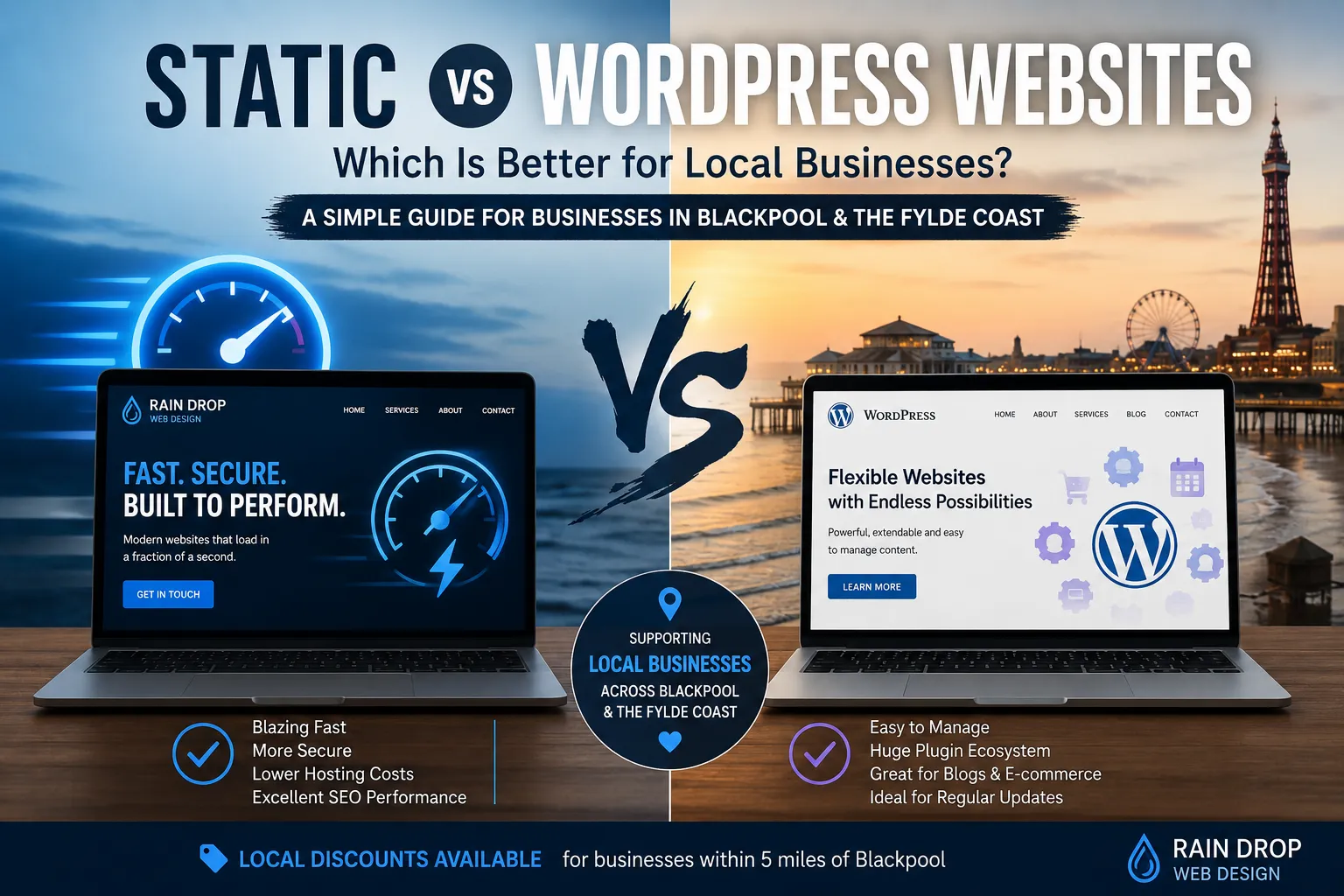
The short answer: static websites are often best for fast, focused local business websites. WordPress is often better when you need regular DIY content updates, ecommerce, bookings, memberships, or more complex functionality.
So which is better for a local business in Blackpool or across the Fylde Coast? It depends. A website for a local electrician has very different needs from a large online shop, booking platform, or membership site.
Let us break it down properly, without pretending there is one perfect answer for everyone.
Great for brochure sites, service pages, local SEO pages, portfolios, and businesses that want a site built to perform.
Great for sites that need frequent DIY updates, blogs, ecommerce, bookings, plugins, and more advanced content management.
What is a WordPress website?
WordPress is what is known as a dynamic content management system, or CMS.
In plain English, that means it builds pages using a database, themes, plugins, and server-side code. When somebody visits your website, WordPress usually has to:
- query the database
- load the theme
- process plugins
- build the page
- send the finished result to the visitor's browser
The big advantage is flexibility. You can log in, edit pages, write blog posts, upload products, install plugins, manage forms, and make updates yourself. That is why WordPress became so popular.
What is a static website?
A static website works differently. Instead of building pages every time somebody visits, the pages are generated in advance.
The finished website is usually delivered as clean HTML, CSS, optimised images, and only the JavaScript that is actually needed. There are no database queries happening for every visitor, no plugin stack being loaded on every page view, and far fewer moving parts.
The result can be a website that loads incredibly quickly.
Modern static websites are often built using frameworks such as Astro, Next.js, Gatsby, or Hugo. Our own Rain Drop website was rebuilt using modern static technology because speed, reliability, and clarity were all big priorities. We wrote more about that in our post on why website speed matters for Fylde Coast businesses.
Why are static websites popular again?
Because a lot of the internet became bloated.
Over time, many websites have been loaded up with page builders, heavy themes, plugins, tracking scripts, oversized images, animations, and bits of code that nobody is quite sure about anymore. Sometimes a site is carrying several megabytes of data just to show a few paragraphs and a contact form.
That is not ideal for someone trying to quickly check your services on a phone.
Modern static websites strip a lot of that back and focus on the things that matter most:
- speed
- mobile usability
- security
- clean page structure
- better user experience
- strong SEO foundations
Website speed matters more than most businesses realise
A slow website does not just mildly annoy people. It can quietly cost you enquiries.
If somebody searches for a local plumber, roofer, photographer, salon, cafe, or accountant and your site takes too long to load, there is a very good chance they will go back to Google and try another result. Most of us are impatient online. We may pretend otherwise, but the back button says a lot.
For local businesses, speed matters because visitors are often comparing several options quickly. They want to know what you do, where you work, whether you look trustworthy, and how to contact you.
A fast, well-structured site gives them fewer reasons to leave.
Static vs WordPress: the useful comparison
Static websites are usually strongest when you need...
- very fast page loading
- a secure brochure-style website
- service pages that support local SEO
- a site that does not rely on lots of plugins
- simple long-term maintenance
- reliable hosting with fewer moving parts
WordPress is usually strongest when you need...
- regular DIY content editing
- advanced blog management
- ecommerce or product catalogues
- bookings, memberships, or customer areas
- a large plugin ecosystem
- multiple users managing content
The advantages of WordPress
WordPress still has plenty going for it. We are not here to bash it with a digital frying pan.
Easy content management
If you want to log in and update your own pages, add blog posts, upload galleries, and make regular changes, WordPress gives you a familiar admin area to do that.
A huge plugin ecosystem
Need bookings, memberships, ecommerce, event listings, customer portals, forms, galleries, or advanced integrations? There is probably a WordPress plugin that can help.
Good for larger dynamic websites
WordPress can be a strong fit for ecommerce stores, magazines, membership websites, directories, and projects where content changes often or needs to be managed by several people.
The downsides of WordPress
The flexibility is useful, but it can come with baggage.
Plugin bloat
Too many plugins can slow a site down, make it harder to maintain, and introduce security risks if updates are ignored.
More maintenance
WordPress sites need theme updates, plugin updates, backups, security checks, and database care.
Performance needs attention
A WordPress site can be fast, but it needs to be built and hosted properly. Poor hosting and heavy page builders can make it feel sluggish.
The advantages of static websites
Static websites are especially useful for many small and local businesses because they focus on performance and simplicity.
Excellent speed
Pages are already generated, so visitors can get the content quickly. That is great for mobile users and impatient humans in general.
Stronger security basics
With no public database or traditional admin login, there are fewer common attack points to worry about.
Reliable and efficient
Static sites are lightweight and stable, especially when paired with fast UK web hosting.
They are also a great match for responsive website design, because the whole site can be planned around speed, mobile usability, clean layouts, and useful content from the start.
The downsides of static websites
Static is not magic. It is a tool, and like any tool, it has places where it fits beautifully and places where it does not.
A static website may not be the best option if you need to log in every day to change content, manage lots of products, run complex bookings, or give customers private account areas. Those features are possible with the right setup, but they need more planning than simply installing a plugin and hoping for the best.
It is also less DIY-friendly for some business owners. If you want full control over every bit of content without asking your web designer, WordPress may feel more comfortable.
Which local businesses suit static websites?
Static websites can be a brilliant fit for businesses that need a fast, professional online presence rather than a complex web app.
For many of these businesses, the website needs to explain services clearly, look professional on mobile, show trust signals, support local search, and make it easy for people to enquire.
That is exactly where static technology can shine, especially when the site is planned around useful content and sensible search engine optimisation.
Which local businesses suit WordPress?
WordPress may be the better choice if the website needs more frequent hands-on content management or dynamic features.
For example, WordPress can work well for:
- online shops with lots of products
- businesses publishing content every week
- sites with several team members editing pages
- booking-heavy businesses
- membership sites or private customer areas
- websites that need lots of third-party integrations
The important thing is to build it properly. WordPress itself is not the problem. Slow themes, unnecessary plugins, poor hosting, and neglected maintenance usually are.
What we recommend at Rain Drop
We do not believe in forcing every client into the same system.
Sometimes WordPress is the right answer. Sometimes a static website is the better option. Sometimes the best route is a hybrid approach where the public-facing site is extremely fast, but certain features are handled separately behind the scenes.
What matters most is choosing the right setup for the job, based on:
- how often the content needs to change
- whether the site needs ecommerce, bookings, or accounts
- how important performance is to the project
- who will manage the website after launch
- what the site needs to achieve for the business
For most small local business websites, speed and clarity win.
If your website mainly needs to explain what you do, build trust, show examples, rank locally, and generate enquiries, a modern static website can be a very strong choice.
Final thoughts
The web is changing. Users expect instant load times, smooth mobile experiences, clear content, and websites that do not feel like hard work.
For many local businesses in Blackpool and across the Fylde Coast, static websites offer a real opportunity to improve speed, create a better user experience, support SEO, and stand out from competitors with older, heavier websites.
WordPress still remains a powerful platform for the right project. The key is choosing the right tool for the job, not just following what everyone else is doing.
If you are not sure which direction your website should take, we are always happy to talk it through and give honest advice. You can also explore the types of local businesses we work with or get in touch when you are ready for a chat.