Articles · Hints & Tips
Are Websites Still Needed in the Era of AI?
AI search is changing how people find local businesses, but websites still matter. Here is why your site now needs to work as a trusted source for AI answers.
Every so often, someone declares that websites are finished.
Social media was going to replace them. Then apps were going to replace them. Then Google Business Profiles were going to replace them. Now AI is apparently lining up with a tiny shovel, ready to bury the humble website for good.
Except it is not that simple.
AI search is changing how people find information. Google has moved far beyond the old list of ten blue links, and AI-generated answers are now part of the search experience. People are asking longer, more specific questions and often getting a usable answer without clicking through to a website at all.
That does not mean websites are no longer needed. It means websites have a different job.
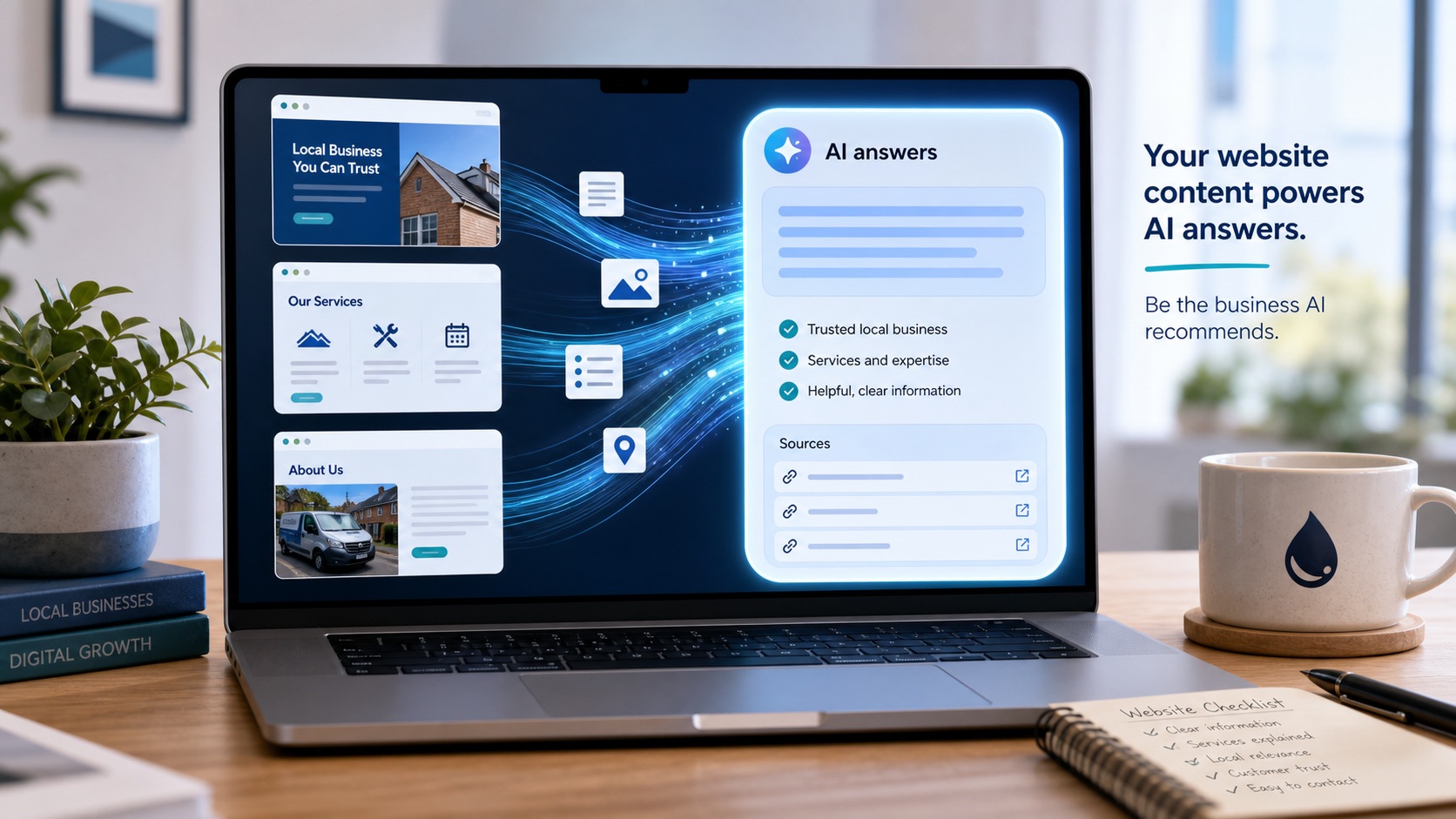
The short version: your website is no longer just a destination for visitors. It is also a source of truth that search engines and AI systems may use to understand, summarise, compare, and recommend your business.
For local businesses in Blackpool, the Fylde Coast, and beyond, this is a big shift. If your website is thin, vague, outdated, or full of generic marketing waffle, AI systems have very little useful information to work with. If your website clearly explains who you help, what you do, where you work, and why customers trust you, it becomes much easier for both humans and machines to understand.
So yes, websites are still needed. But the content on them needs to grow up a bit.
What has actually changed in search?
Traditional SEO used to be largely about helping your pages rank in search results so people would click through to your website. That still matters, but the journey is becoming less direct.
Google now shows AI Overviews for many searches, and AI Mode is pushing search further towards a conversational answer engine. In May 2025, Google said AI Overviews were driving more than a 10% increase in usage for the types of queries where they appear in major markets such as the US and India. In May 2026, Google also said AI Mode had passed one billion monthly active users globally, with the average AI Mode query around three times longer than a traditional search query.
That last point matters. People are no longer only typing short phrases like:
- web designer Blackpool
- roofer near me
- best cafe Lytham
They are asking messier, more human questions such as:
- who can build a fast website for a small business in Blackpool without a huge upfront cost?
- which local roofer has experience with flat roofs and good reviews?
- what should I look for when choosing a photographer for a small business website?
That shift changes the kind of content your website needs. AI systems are looking for answers, evidence, context, and confidence. A page that simply says "we offer high quality services at competitive prices" is not giving them much to go on. To be fair, it does not give humans much either.
The click is becoming less guaranteed
One uncomfortable part of this conversation is that website visits may become harder to win from some types of search.
This was already happening before AI became the headline. SparkToro and Datos analysed Google search behaviour in 2024 and found that 59.7% of EU Google searches and 58.5% of US Google searches ended without a click. Their study also estimated that, for every 1,000 Google searches, only 374 clicks in the EU and 360 clicks in the US went to the open web.
AI summaries appear to intensify that pattern. Pew Research Center analysed US browsing behaviour from March 2025 and found that people clicked a traditional search result on 8% of visits where an AI summary appeared, compared with 15% of visits without one. Pew also found that links inside the AI summary itself were clicked in only 1% of visits where a summary appeared.
Zero-click searches were already common, and AI answers can make quick information searches even less click-heavy.
If AI mentions, summarises, or recommends your business, your website may influence the decision even when the first interaction happens elsewhere.
This does not mean traffic is dead. It does mean we need to stop treating every search as a simple journey from keyword to ranking to click. Some searches will end inside Google. Some will lead to a call, a map result, a branded search, or a later visit. Some will influence a decision without showing up neatly in analytics.
That is irritating for reporting, but useful to understand. Your website may be doing work even when the path is less visible.
Why websites still matter to AI search
AI systems do not magically know your business. They need sources.
For a local business, those sources may include your website, Google Business Profile, reviews, directories, social profiles, local press, industry websites, and other pages that mention you. Your website is the part you have the most control over.
That makes it important for three reasons.
Your website defines your business clearly
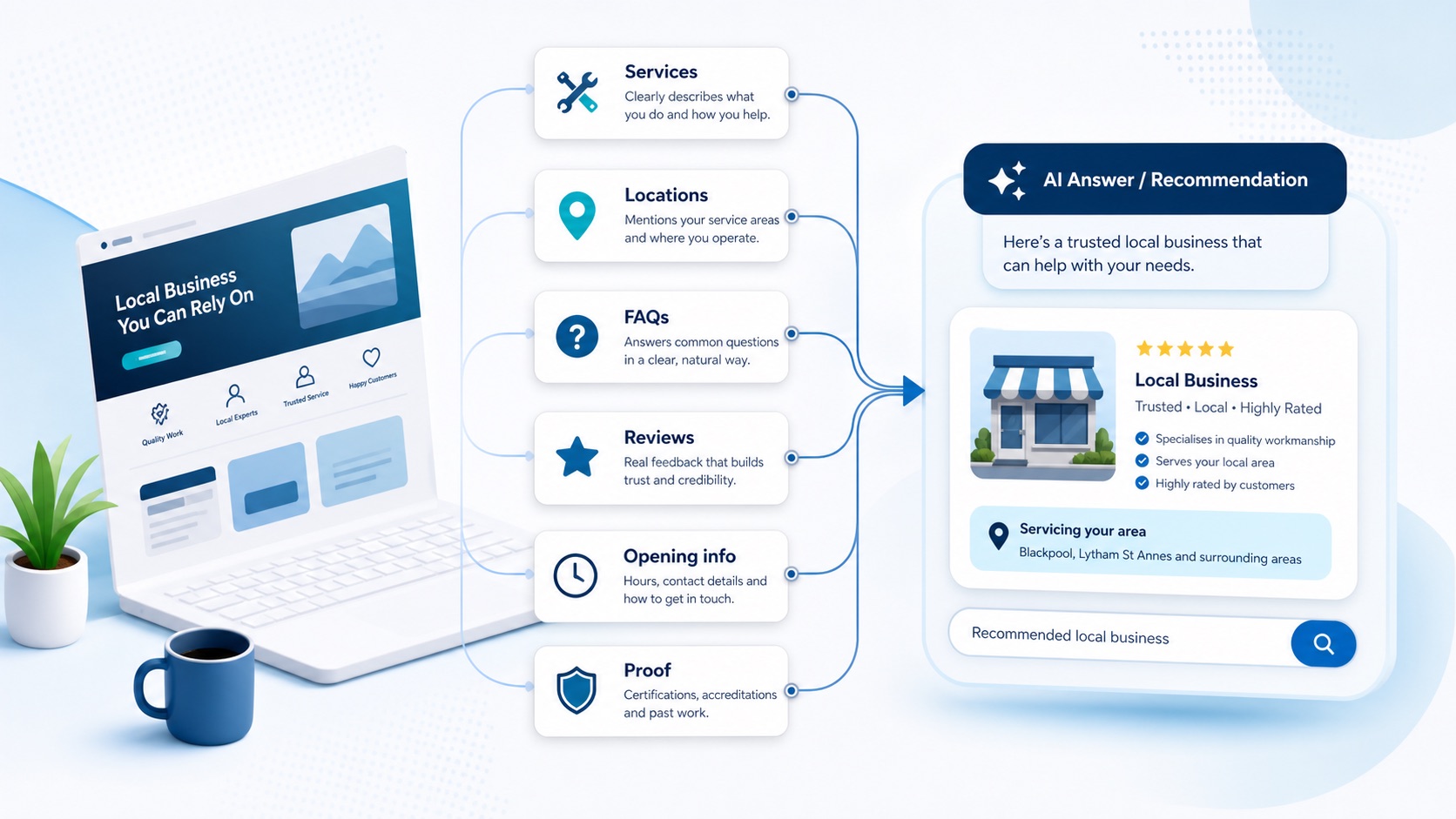
It should explain your services, locations, customers, process, proof, and contact details in one consistent place.
Your website gives AI something to cite
Search systems need reliable web content to support answers. Thin pages give them very little confidence.
Your website converts serious visitors
When someone does click through, they are often closer to making a decision and need reassurance quickly.
Google's own guidance for AI features still points back to familiar fundamentals: useful content for people, strong page experience, crawlable pages, accurate structured data, and visible content that matches the markup. Google also says there is no special AI-only schema you need to add to appear in AI features.
That is important. You do not need a magic "AI optimisation" button. You need a website that is clear, useful, technically sound, and genuinely informative.
The old website content model is not enough
A lot of small business websites were built around a very simple structure:
- Homepage
- About page
- Services page
- Gallery or portfolio
- Contact page
That structure can still work, but the content inside those pages often needs more depth. AI search is better at handling nuance, which means vague content becomes easier to ignore.
Imagine two roofing websites.
Website A says...
- We offer roofing services.
- We are reliable and affordable.
- Contact us for a quote.
Website B explains...
- Which roofing services it offers.
- Which towns and areas it covers.
- What types of jobs it handles.
- What customers should expect from the process.
- Common questions about repairs, flat roofs, leadwork, and emergency callouts.
- Examples of completed work and real reviews.
Website B gives AI systems far more to understand. It also gives potential customers far more confidence. That is the sweet spot: content that helps machines because it already helps people.
What should change on business websites?
The answer is not to write robotic pages for AI. Please do not do that. Nobody wants to read a website that sounds like it was assembled in a spreadsheet by someone who has never had a cup of tea with a customer.
The better approach is to make your content more specific, structured, and useful.
1. Explain services in plain English
Do not just list service names. Explain what each service includes, who it is for, and what problem it solves.
For example, instead of a decorator saying:
We offer painting and decorating services.
They could explain:
We help homeowners, landlords, and small businesses with interior painting, exterior painting, wallpapering, rental refreshes, and full room redecorations across Blackpool and the Fylde Coast.
The second version gives more context. It identifies customers, services, locations, and use cases. That is useful for visitors and much easier for AI systems to interpret.
2. Build proper pages for important services
If a service matters commercially, it probably deserves its own page. A single "Services" page with eight short bullet points often is not enough.
Separate pages give you room to answer specific questions, show relevant examples, explain benefits, and include the right internal links. For Rain Drop, that is why pages such as responsive website design, search engine optimisation, and fast UK web hosting are separate rather than crammed into one vague page.
3. Make location relevance clear
Local businesses need to make geography obvious without sounding like they are stuffing town names into every sentence.
A good local page should explain:
- where the business is based
- which areas it serves
- whether it works from premises, visits customers, or operates remotely
- any local knowledge that genuinely matters
- how people in those areas can get in touch or request help
For local SEO and AI search, this helps connect the business to real places. For customers, it answers the basic question: "Can they actually help me where I am?"
4. Add FAQs that answer real buying questions
FAQs are useful because people search in questions, and AI systems often respond to question-style queries. But FAQs only help if they are genuinely useful.
Good FAQ topics include:
- how much a service usually depends on scope
- what is included
- how long the work takes
- which areas are covered
- what customers need to prepare
- what happens after someone enquires
Bad FAQs are the ones nobody has ever asked, written only to squeeze in another keyword. You know the type. They have the warmth of a printer manual.
5. Show proof, not just promises
AI systems are not only looking for what you claim. They may also pick up signals of trust and consistency from the wider web.
Your website should make trust easier to understand by including:
- real customer reviews or testimonials
- case studies or project examples
- before and after photos where relevant
- accreditations, qualifications, or memberships
- clear contact details
- an honest About page
This is especially important for local service businesses where trust is a big part of the buying decision. A visitor wants to know you are real, reliable, and not going to vanish after the deposit clears.
6. Keep business information consistent
Your website should agree with your Google Business Profile, directory listings, social profiles, and review platforms.
Check that your business name, services, locations, contact details, opening information, and descriptions are consistent. If your website says one thing, your Google profile says another, and an old directory listing says something from 2017, you are making life harder for search engines and customers.
7. Use structured data properly
Structured data is not a shortcut to AI visibility, but it can help search engines understand page information more clearly. The important bit is accuracy. The structured data should match what is visibly on the page.
For example:
- Service pages can use service-related schema.
- Blog posts should use article schema.
- Visible FAQs can use FAQ schema.
- Business details should be accurate and visible if marked up.
That is how this website is set up: service schema comes from the service page data, blog schema comes from the blog template, and FAQ schema is only used when the FAQ is visible on the page.
What does AI-friendly content look like?
AI-friendly content is not a separate species of content. It is simply clearer and more complete.
Specific
It names the services, customers, locations, problems, outcomes, and examples that matter.
Structured
It uses clear headings, short sections, FAQs, lists, and logical page relationships.
Trustworthy
It includes proof, reviews, examples, contact details, and accurate business information.
For example, a photographer's website should not only say "professional photography services". It should explain whether they offer weddings, commercial shoots, product photography, property photography, headshots, event photography, editing, turnaround times, locations covered, usage rights, and what happens before the shoot.
A cafe website should not only say "fresh food and great coffee". It should include opening times, menus, dietary information, booking details if relevant, accessibility notes, local area, photos, reviews, and what makes the place worth choosing.
A web designer's website should not only say "modern websites". It should explain the process, pricing approach, hosting, support, technologies used, performance, SEO foundations, portfolio examples, and what kind of businesses are a good fit. That is one reason we have been adding more detailed guides and service pages across this site, including posts on static vs WordPress websites and why website speed matters.
The website becomes the evidence layer
In the old model, the website was often treated as the final destination. Someone searched, clicked, read, and contacted you.
In the AI search model, the website also acts as an evidence layer. It helps answer engines build a picture of your business before the visitor arrives.
That means your content needs to support questions such as:
- What does this business actually do?
- Who is it best suited for?
- Where does it operate?
- What makes it credible?
- What proof exists?
- What are the next steps for a customer?
- Is the information current?
If your website cannot answer those questions clearly, AI systems may fill the gap from other sources, ignore you, or misunderstand what you offer. None of those are ideal.
Do small businesses need to chase every AI trend?
No. Please do not spend your week panicking about every new acronym. SEO, AEO, GEO, LLMO... at some point it starts to sound like someone dropped a Scrabble bag down the stairs.
Most small businesses should focus on the practical fundamentals:
- make sure your site can be crawled and indexed
- write clear service pages
- answer real customer questions
- keep your Google Business Profile accurate
- collect genuine reviews
- show examples of your work
- keep pages fast and mobile-friendly
- use sensible schema where it matches visible content
- update old pages when services, prices, or locations change
Those things helped before AI. They help even more now.
What about traffic drops?
Some websites will see fewer visits for informational searches. If someone asks a simple question and the answer appears directly in Google, they may not click. That is not new, but AI makes it more noticeable.
The practical response is to think about different types of searches.
Low-intent searches
- simple definitions
- basic how-to questions
- quick factual answers
- early research queries
These may become more zero-click. Your content can still build visibility, but clicks may be lower.
High-intent searches
- local service comparisons
- quote and pricing research
- portfolio checks
- trust and review validation
These still need strong pages because serious customers want detail before they enquire.
The goal is not only to win more traffic. It is to win better visibility, better-fit enquiries, and more trust when people are close to making a decision.
So, are websites still needed?
Yes. More than ever, but not in quite the same way.
A website is still the place where you control your message, explain your services properly, show proof, publish helpful content, and convert interested visitors. It is also becoming a key source that AI systems can use to understand whether your business is relevant to a searcher's question.
The businesses that struggle will be the ones with thin, generic, neglected websites. The businesses that benefit will be the ones with clear, useful, well-structured content that makes their expertise easy to understand.
Your website should now answer humans and inform AI.
That does not mean writing for robots. It means being clearer, more specific, more helpful, and more trustworthy than the businesses still hiding behind vague one-page websites.
A sensible next step
If your website has not been reviewed for a while, read it through with one question in mind: could someone, or an AI system, confidently explain what your business does after reading it?
If the answer is "sort of", there is room to improve.
You do not need to rewrite everything overnight. Start with your most important service pages, your About page, your FAQs, and your proof. Make them clearer. Make them more useful. Remove vague claims and replace them with specific details.
If you would like help making your website easier for visitors and search engines to understand, we are always happy to talk it through. We can usually point you in the right direction, even if you are not quite sure what needs changing yet.
Sources and further reading
- Google: AI in Search updates from Google I/O 2025
- Google: How AI Mode is changing and expanding the way people search
- Pew Research Center: Google users are less likely to click links when an AI summary appears
- SparkToro: 2024 zero-click search study
- Google Search Central: AI features and your website
- Google Search Central: succeeding in AI search experiences