Articles · Hints & Tips
How to Make Your Website More Useful in AI Search Results
AI search is changing how people find local businesses. Here is how to make your website clearer, more useful and easier for search engines to understand without chasing gimmicks.
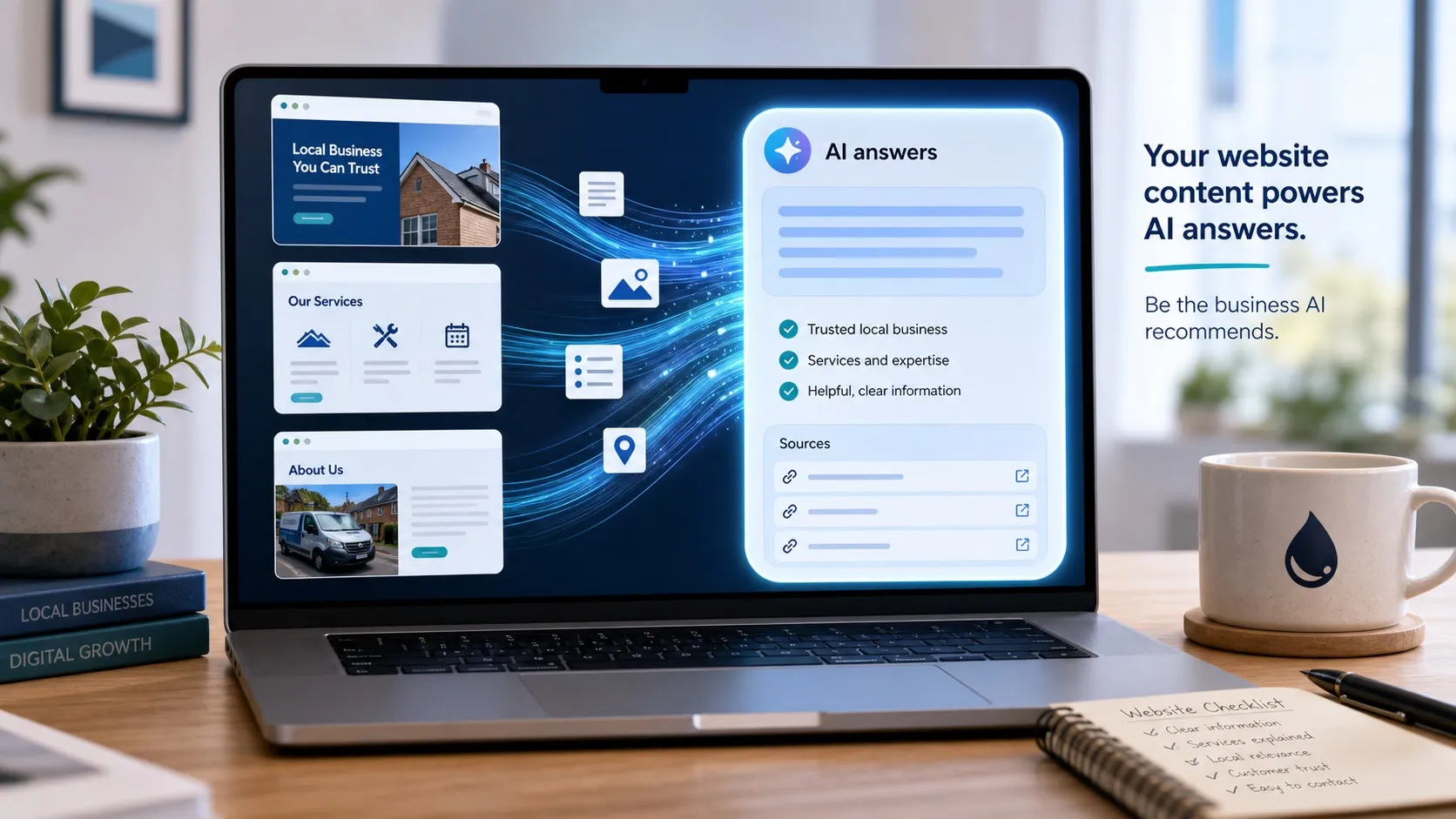
AI search has made website owners nervous.
Understandably, really.
For years, businesses were told to think about keywords, Google rankings, blog posts, backlinks, mobile speed, reviews, maps, and a dozen other things. Now AI has walked into the room and everyone is wondering whether the old rules have been thrown in the bin.
The honest answer is less dramatic.
AI search does change how people find information, but it has not removed the need for clear, useful websites. If anything, it has made vague websites even easier to ignore.
If your website properly explains what you do, who you help, where you work, why customers trust you, and what someone should do next, it is more useful to visitors. It is also easier for search engines and AI systems to understand.
No magic wand required. Which is a shame, because a magic wand would be very handy during DNS changes.
First, What Do We Mean by AI Search?
AI search means search results that use generative AI to summarise, compare, or answer questions instead of simply showing a list of links.
Google has AI Overviews and AI Mode. Other tools, including ChatGPT and Perplexity, can also answer questions using information from across the web. People are getting used to asking longer, more specific questions such as:
- who can build a fast website for a small business in Blackpool?
- what should I look for before choosing a web designer?
- which local business looks trustworthy for this type of work?
- does this company offer support after the website goes live?
That matters because those questions need actual answers. A thin website with generic copy gives AI systems very little to work with.
We covered the bigger picture in Are websites still needed in the era of AI?. This post is more practical: what can you actually improve on your website?
Start With the Boring Stuff, Because It Works
There is a lot of dramatic advice online about AI search.
Some of it sounds like you need to rebuild your entire website, rename every heading, add seventeen bits of mysterious schema, and sacrifice your old blog archive to the algorithm.
You do not.
Google's own guidance for AI features still points back to familiar basics: make sure your pages can be crawled and indexed, create helpful content for people, provide a good page experience, use accurate structured data where relevant, and make sure important information is visible on the page.
In plain English: write useful pages, make them technically accessible, and do not hide the important bits.
That may not sound exciting, but neither does checking tyre pressure. Still quite useful before a long drive.
Make Your Services Clear Enough to Quote Back
If someone asked an AI system to describe your business, would your website give it enough detail?
Many small business websites say things like:
We offer a wide range of professional services at competitive prices.
That sentence is not evil. It is just not very helpful.
A better website explains:
- what services you provide
- who those services are for
- what problems you solve
- what is included
- what makes your approach different
- which services matter most commercially
For example, a decorator should not only say they offer decorating. They should explain whether they handle interior painting, exterior painting, wallpapering, rental refreshes, commercial work, full room redecorations, or small touch-up jobs.
The more specific your content is, the easier it is for humans and AI systems to understand when your business is a good match.
Give Important Services Their Own Pages
If a service brings in enquiries, it probably deserves more than one bullet point on a general services page.
Separate service pages give you room to answer real questions, show relevant examples, explain the process, and include details that would make a single page feel cluttered.
That is why Rain Drop has separate pages for responsive web design, search engine optimisation, fast UK web hosting, and other core services. Each page has a different job.
This helps search engines understand the topic of each page. It also helps potential customers find the information that matches what they actually need.
Answer the Questions Customers Really Ask
AI search is built around questions. That does not mean every page needs a giant FAQ section, but your website should answer the things people genuinely want to know before they contact you.
Useful questions might include:
- what is included?
- how long does it usually take?
- who is this best suited to?
- what do customers need to prepare?
- which areas do you cover?
- do you offer ongoing support?
- what happens after someone enquires?
- what makes this different from a cheaper alternative?
These questions are useful because they sit close to buying decisions. They are the things people wonder about quietly before they send an enquiry.
If you are not sure what to prepare before a website project starts, we have a separate guide on what content you need before a web designer can start.
Make Local Relevance Obvious
For local businesses, AI search still needs to understand geography.
If you work in Blackpool, Lytham, St Annes, Poulton, Cleveleys, Fleetwood, Thornton, Bispham, Kirkham, or across the Fylde Coast, your website should say that clearly and naturally.
Do not cram town names into every sentence. Nobody enjoys reading that, and it makes the page feel like it has been assembled by a spreadsheet with a grudge.
Instead, be genuinely useful:
- explain where you are based
- list the main areas you cover
- mention whether you visit customers or work remotely
- show examples of local work where possible
- keep your Google Business Profile details consistent with your website
This helps search engines connect your business with real places. More importantly, it answers the customer's basic question: can you actually help me where I am?
Show Proof, Not Just Claims
AI systems may summarise what your website says, but people still need reasons to trust you.
A website that says "we are trusted" is fine. A website that shows real evidence is better.
Useful trust signals include:
- genuine customer reviews
- case studies or portfolio examples
- project photos
- before and after images where relevant
- accreditations or qualifications
- clear contact details
- an About page that sounds like a real business
- links to active, consistent business profiles
Our portfolio exists for exactly this reason. People should be able to see real examples before deciding whether Rain Drop feels like the right fit.
Proof gives visitors confidence. It also gives search engines more context about your business, your work, and your credibility.
Keep Your Website and Google Business Profile Consistent
For local businesses, your website is only one part of the picture.
Your Google Business Profile, reviews, directory listings, social profiles, and website should all broadly agree with each other. If one place says you cover Blackpool, another says Manchester, and an old listing still has an email address from 2014, that is not ideal.
Check that the basics match:
- business name
- phone number
- email address
- website URL
- services
- opening hours
- business description
- areas served
If your Google profile has been ignored for a while, our older guide to Google My Business SEO is still a useful starting point.
Use Plain Language Instead of AI Bait
This is worth saying clearly: do not write your website for AI.
Write for the person who might become your customer.
The best AI-search improvements usually make the website better for humans too. Clear headings. Useful answers. Real examples. Sensible page structure. Fast loading. Accurate details. No vague waffle.
Trying to sound "optimised for AI" usually has the opposite effect. You end up with content like:
Our comprehensive solutions empower clients through innovative excellence across dynamic service landscapes.
Which is technically English, but only in the same way that a traffic cone is technically furniture if you are desperate enough.
Plain language wins because people understand it. Search engines are fairly keen on understanding things too.
Make Sure Search Engines Can Actually Read the Page
This is the less glamorous bit, but it matters.
If important content is hidden, blocked, loaded awkwardly, or trapped inside images, search engines may struggle to understand it properly.
Your website should have:
- crawlable pages
- clear HTML headings
- useful page titles and descriptions
- internal links between related pages
- descriptive image alt text where images matter
- visible content that matches any structured data
- a mobile-friendly layout
- fast loading pages
This is one reason modern, lightweight websites can be useful. They remove a lot of the clutter that gets in the way of both visitors and search engines.
If your current website is slow, messy, or difficult to maintain, our post on how to tell if your website is out of date covers the warning signs.
Do You Need Special AI Schema?
No.
At least, not in the way some people make it sound.
Google says there are no additional technical requirements for content to appear in AI features, beyond following the normal Search essentials. Structured data can still help search engines understand a page, but it needs to be accurate and match what visitors can actually see.
In other words, schema is not a secret shortcut. It is a clearer label on information that should already be true and visible.
Good website structure matters more than sprinkling technical confetti over weak content.
A Simple AI Search Website Checklist
If you want a practical starting point, check whether your website clearly answers these:
- What does the business actually do?
- Who does it help?
- Where does it operate?
- What are the main services or products?
- What makes the business trustworthy?
- What common questions do customers ask?
- Are reviews, examples, or proof easy to find?
- Is the content current?
- Does the website agree with the Google Business Profile?
- Can visitors contact the business easily?
If your website struggles with several of those, AI search is not really the core problem. The core problem is that the website is not clear enough yet.
Final Thoughts
AI search is new in some ways, but the sensible response is surprisingly old-fashioned.
Be clear. Be useful. Be specific. Show proof. Keep your information accurate. Make the website easy to use. Avoid writing like you have swallowed a marketing brochure.
That approach helps AI search because it helps people first.
If your website needs clearer service pages, better local content, stronger SEO foundations, or a calmer structure that makes more sense to potential customers, feel free to get in touch. We can help you work out what is worth improving without turning the whole thing into an AI science project.
For reference, Google’s own guidance on AI features in Search is available from Google Search Central.