Articles · Hints & Tips
Why AI Website Builders Fall Short for Business Websites
AI website builders can look impressive at first, but business websites need strategy, testing, experience, and human judgement. Here is why a proper web designer still matters.
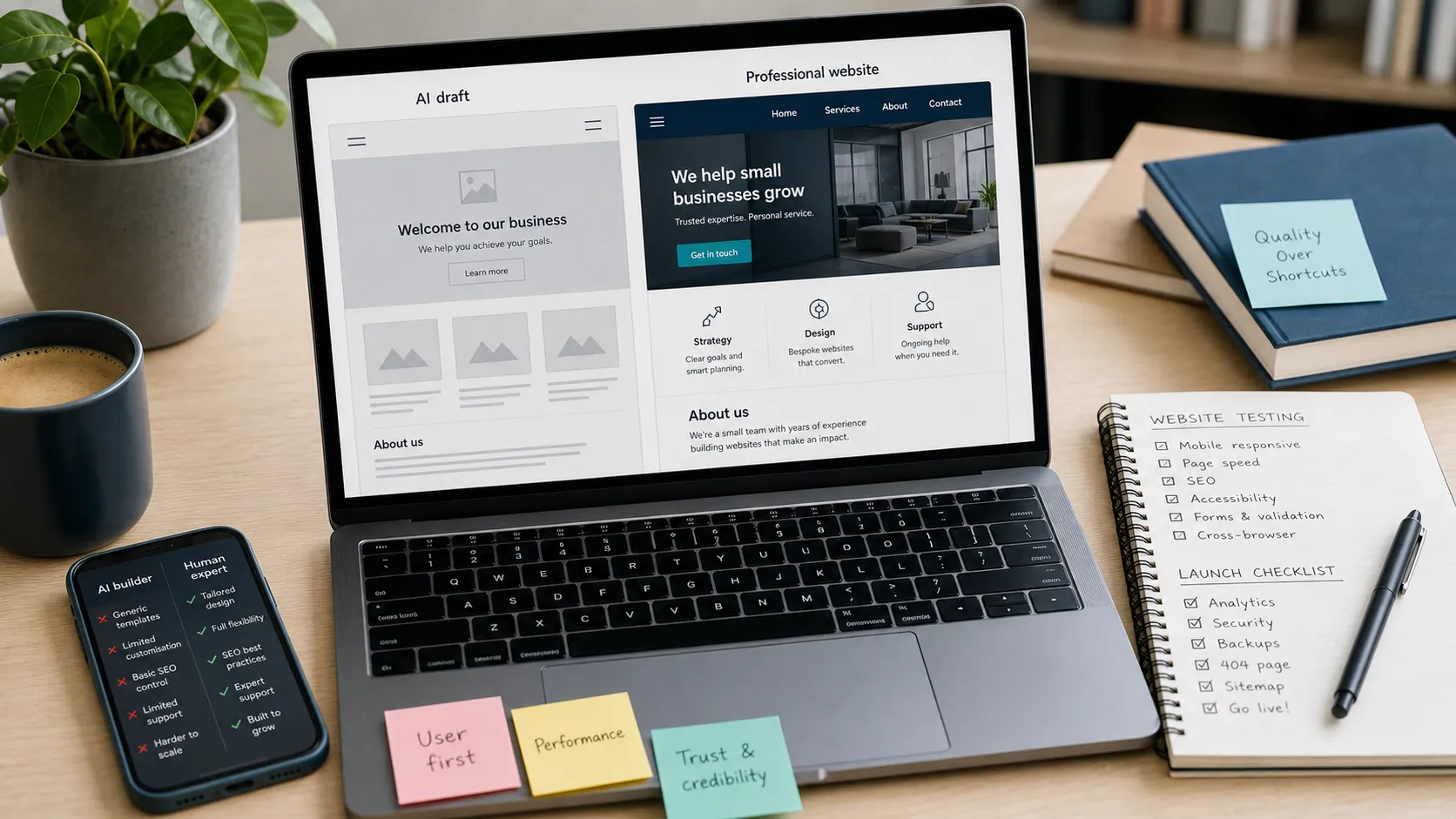
AI website builders are getting better.
Some of them can create a page in minutes. You type in a few details about your business, choose a style, press a button, and suddenly there it is: a homepage, a few sections, some stock-style images, a contact form, and enough generic confidence to fill a LinkedIn post.
That can be impressive.
It can also be misleading.
A website that appears quickly is not automatically a website that will work well for your business. There is a big difference between generating a design and building something that helps real customers trust you, understand what you do, find you on Google, use the site easily on mobile, and actually get in touch.
That difference is where a proper web designer or developer still matters.
And yes, that includes designers who use AI as part of their work. There is nothing wrong with using AI to speed up ideas, draft content, test layouts, organise notes, or support development. The problem is not AI existing. The problem is handing your entire business website to a tool that does not truly understand your business, your customers, your local market, or the consequences if the site does not perform.
The short version: an AI website builder can produce a website. A good web designer builds a business tool. Those are not the same thing.
AI Website Builders Usually Start With the Wrong Question
Most AI website builders begin by asking something like:
"What type of website do you want to create?"
That sounds reasonable, but it is not really where a serious business website should start.
A proper web designer is more likely to ask:
- What do you want the website to achieve?
- Who are your best customers?
- Which services matter most commercially?
- Where do your customers come from?
- What makes people hesitate before contacting you?
- What do competitors say that you need to answer better?
- What should a visitor be able to do within the first few seconds?
Those questions change the website.
A tradesperson who wants emergency callouts needs a very different site from a wedding photographer, a guest house, a charity, a salon, or a consultant. The page structure, calls to action, imagery, proof, mobile layout, and content depth should all reflect how customers make decisions.
An AI builder might give all of them a pleasant homepage with a smiling hero section and three feature cards. Which is fine, if the goal is to look vaguely present on the internet.
Most businesses need more than vaguely present.
Templates Cannot Replace Experience
AI builders are often very good at producing something that looks website-shaped.
They know the common patterns: hero area, services row, about section, testimonials, contact form, footer. The trouble is that knowing the pattern is not the same as knowing why it should be used, when it should be changed, or what should be removed entirely.
Experience helps a designer spot things an automated builder will usually miss:
- the headline is too vague
- the most profitable service is buried halfway down the page
- the contact form asks too much too soon
- the mobile layout makes the phone number hard to find
- the photos do not build trust
- the page looks nice but does not answer the buying question
- the design feels too generic for the type of business
These are not tiny details. They affect whether people stay, understand, trust, and enquire.
A good designer has seen what happens when websites underperform. They have dealt with vague briefs, missing logos, broken forms, slow hosting, confusing navigation, awkward mobile layouts, half-finished content, and customers who say, "I just want people to call me."
That real-world experience is difficult to automate because it comes from seeing how websites behave after launch, not just how they look in a preview.
A Business Website Needs Proper Content Thinking
One of the biggest weaknesses of AI-built websites is content.
They often sound confident but say very little.
"We provide high-quality solutions tailored to your needs."
That sentence could belong to a plumber, accountant, dog groomer, IT company, decorator, leadership coach, or someone selling suspiciously expensive candles. It is smooth, but it is not useful.
A business website needs content that explains:
- what the business actually does
- who it helps
- where it works
- what each service includes
- why customers should trust it
- what makes it different from nearby competitors
- what someone should do next
This is especially important for small businesses in Blackpool and across the Fylde Coast, where customers often compare several local options before making contact.
A proper designer should help shape the content around real buying decisions. That might mean creating separate service pages, adding FAQs, improving the About page, showing real reviews, or making the contact path easier.
Our guide to what pages a small business website should include covers this in more detail. Page structure is not just admin. It shapes how people understand your business.
AI Builders Do Not Really Know Your Local Market
An AI website builder can write "serving your local area" very easily.
It does not necessarily understand your actual local area.
For a local business, that matters. A website for a Blackpool guest house needs different emphasis from a website for a Lytham professional service, a Poulton tradesperson, a Cleveleys cafe, or a Fleetwood community organisation.
A human designer can think about:
- the kind of customers in the area
- whether visitors are local residents, tourists, businesses, or homeowners
- how people are likely to search
- which service areas should be mentioned
- how to avoid thin location pages that feel copied and pasted
- how to connect the website with Google Business Profile and local SEO
AI can help draft local content, but it still needs human judgement. Otherwise you can end up with pages that mention place names without saying anything specific or helpful.
That kind of content does not build much trust. It just waves at SEO from a distance.
Design Is More Than Making It Look Nice
AI builders can create attractive layouts. That is part of the appeal.
But good web design is not just decoration. It is decision-making.
A designer is thinking about:
- where the eye goes first
- which information needs priority
- whether the page works on a small phone
- whether buttons are easy to tap
- whether text is readable
- whether the design feels trustworthy for the business type
- whether the page is too busy
- whether the call to action appears at the right moment
That is why a website can look good in a screenshot but still feel awkward to use.
A homepage might have a beautiful hero image, but if it pushes the phone number too far down on mobile, it is failing a very practical test. A service page might look modern, but if it never explains the service clearly, it is just wearing a nice jacket while being unhelpful.
Good responsive web design balances how the site looks with how it actually works for customers.
Testing Is Where Many AI Builder Sites Fall Apart
This is one of the biggest differences.
A proper web designer or developer should test the website before it goes live. Not just glance at it on a laptop and say, "seems fine." Actual testing.
That might include:
- mobile layout checks
- tablet and desktop checks
- browser testing
- form testing
- link checks
- page speed testing
- accessibility checks
- image optimisation
- metadata checks
- analytics checks
- 404 and redirect checks
- basic security and SSL checks
An AI website builder may generate a site, but it will not care in the same way whether your enquiry form quietly fails, whether a key button is awkward on an older iPhone, whether your images are too heavy, whether your headings make sense, or whether your thank-you page is tracked properly.
That stuff is not glamorous.
It is also where a lot of business websites win or lose enquiries.
If your website looks fine but your contact form does not reliably deliver messages, the design has failed. If your mobile layout hides the most important action, the design has failed. If the page takes forever to load, people may leave before they even see the clever AI-generated layout.
We have written before about why websites lose customers, and many of those problems come down to testing, clarity, and performance rather than raw visual style.
Performance Needs More Than a Pretty Template
Speed matters. Especially on mobile.
Some website builders create pages that look fine but carry a lot of unnecessary code, scripts, animations, fonts, tracking snippets, and oversized images. The site might feel acceptable on fast broadband in a preview, then crawl along when someone checks it outside with a weak mobile signal.
A developer can make better decisions about:
- image sizes and formats
- how much JavaScript is really needed
- hosting quality
- font loading
- layout stability
- Core Web Vitals
- caching
- removing unnecessary bloat
Those decisions do not always show up in a design preview, but visitors feel them.
Fast websites feel easier to use. They are less frustrating. They can support SEO. They can also make a small business feel more professional before the visitor has read a single word.
This is why we care so much about lightweight builds and fast UK web hosting. Performance is not a nice extra. It is part of the customer experience.
SEO Is Not Just Sprinkling Keywords Around
AI builders often promise SEO help.
Sometimes that means they generate page titles, descriptions, headings, and a few blocks of keyword-friendly copy. Useful? Sometimes. Enough? Usually not.
Real SEO for a business website involves more joined-up thinking:
- which services deserve their own pages
- which search terms actually match buyer intent
- how pages link to each other
- whether the content answers real questions
- whether the site is crawlable
- whether structured data is accurate
- whether local signals are consistent
- whether the site deserves to rank compared with competitors
SEO is not magic, but it does require judgement.
A good designer or developer will not simply ask AI to write "best plumber Blackpool" twelve times and call it a strategy. They will think about what pages should exist, what each page should answer, how the site supports local search, and how the website fits with Google Business Profile, reviews, and wider trust signals.
If you want the deeper version, our posts on why a competitor may rank above you on Google and making your website more useful in AI search results both cover related ground.
Accessibility and Usability Need Human Attention
A website should be usable by as many people as possible.
That means thinking about contrast, readable text, keyboard focus, form labels, heading structure, tap targets, error messages, and whether the site still works when someone is using assistive technology or a less-than-perfect device.
AI builders may include some accessibility-friendly defaults, but defaults are not the same as checking the finished site.
A human designer can spot things like:
- pale text that looks stylish but is hard to read
- buttons that are too small on mobile
- images that need meaningful alt text
- forms that are confusing when an error appears
- heading levels that make the page structure messy
- menus that are awkward to use with a keyboard
These details matter because real visitors are not all using the same device, eyesight, speed, browser, or patience level.
A website should not only work for the person who built it on a large monitor. It should work for the customer trying to find your phone number on a busy lunch break, in the rain, with one bar of signal and very little tolerance for nonsense.
You Need Someone Accountable
This is not talked about enough.
When an AI website builder gives you a site that is slow, confusing, poorly structured, weak on SEO, or awkward on mobile, who is responsible?
You are, mostly.
The tool did what it was asked to do. It generated something. But it is not going to sit with you and work out why enquiries are not coming in. It will not challenge your vague service descriptions. It will not notice that your best proof is missing. It will not care that the form sends enquiries to an old email address.
A good web designer gives you something AI builders cannot: accountability.
Someone has thought about the decisions. Someone has tested the result. Someone can explain why the site is structured that way. Someone can improve it later when the business changes.
That ongoing relationship matters for small businesses because websites are rarely "done" forever. Services change. Prices change. Staff change. Photos get updated. Google changes. Competitors improve. Your website should be able to move with the business.
That is where website maintenance and long-term support become valuable, especially if you do not want to wrestle with the technical bits yourself.
Using AI as a Tool Is Different From Relying on an AI Builder
This is the bit that often gets missed.
A human web designer using AI is not the same thing as an AI website builder replacing the designer.
AI can be genuinely useful in professional hands. It can help explore layout ideas, organise content, draft first-pass copy, check wording, generate image concepts, speed up repetitive development work, or help test different approaches.
But the human still decides:
- what is appropriate for the business
- what should be edited or ignored
- what needs testing
- what the user journey should be
- what content is accurate
- what will build trust
- what the final quality bar should be
That is the important distinction.
A hammer does not make someone a joiner. A camera does not make someone a photographer. AI does not automatically make a website effective.
The value is in the judgement behind the tool.
When Might an AI Website Builder Be Fine?
To be fair, there are situations where an AI website builder might be enough.
If you need a very temporary page, a personal experiment, a quick idea, or a simple placeholder while a business is still taking shape, it might do the job.
Not every project needs a full professional build from day one.
But if your website needs to generate enquiries, support local SEO, build trust, explain services clearly, load quickly, work properly on mobile, and represent your business professionally, the stakes are higher.
At that point, the question is not:
"Can AI make me a website?"
It is:
"Can this website genuinely help my business win more of the right customers?"
That second question is where a proper designer earns their keep.
A Better Website Needs Human Judgement
A good business website is a mix of strategy, design, development, content, SEO, testing, performance, accessibility, and support.
AI can help with parts of that process. It can speed things up. It can support ideas. It can be useful.
But it should not replace the thinking.
For small businesses, the best website is usually not the one that was generated fastest. It is the one that makes customers feel confident, answers their questions, works properly on their device, loads quickly, appears trustworthy, and makes the next step easy.
That takes experience.
It takes testing.
It takes someone caring about the result after the page has been created.
Need a Website Built With Proper Care?
At Rain Drop, we use modern tools where they help, but every website still needs human planning, design judgement, testing, and support. If you want a business website that is built around real customers rather than a generic AI template, we are always happy to chat.
You can look through our recent work, read more about our web design service, or get in touch for honest advice.